Destination, hotel name or experience

Boutique and Luxury Hotels Rajasthan

Introducing Rajasthan

Boutique hotels in Rajasthan run from the active royal palaces of Jodhpur and Jaipur into the Thar Desert proper at Jaisalmer — a state the size of Germany with a culture, cuisine and architectural register distinct from anywhere else in India. Rajasthan was never directly colonised; the British administered through a federation of twenty-one princely states whose maharajas retained their courts and forts, which is why the architectural inheritance is so dense and so much of it remains in royal-family hands. Kipling, who travelled through Rajputana in 1887 as a young journalist, called it the land where the past has never been allowed to die.
 
The state divides into three traveller-distinct regions. The east around Jaipur — the Pink City, the tourist circuit. The centre around Jodhpur, the Blue City of the Marwar region — denser, less visited, with the largest functioning royal palace in India and the desert villages of the Bishnoi within an hour's drive. And the west around Jaisalmer, the Golden City — five hundred kilometres further into the Thar Desert, built entirely in honey-coloured sandstone, closer in feel to Central Asia than to anywhere else in India.
 
Jodhpur — the Blue City
Rajasthan's second-largest city, founded 1459, named for the Marwar dynasty that ruled here for five centuries. The old town below Mehrangarh Fort is a maze of indigo-painted houses — the colour originally a Brahmin caste marker, now a city-wide tradition. Jodhpur is the practical base for exploring central Rajasthan and the launch point for desert excursions into the Marwar.
 
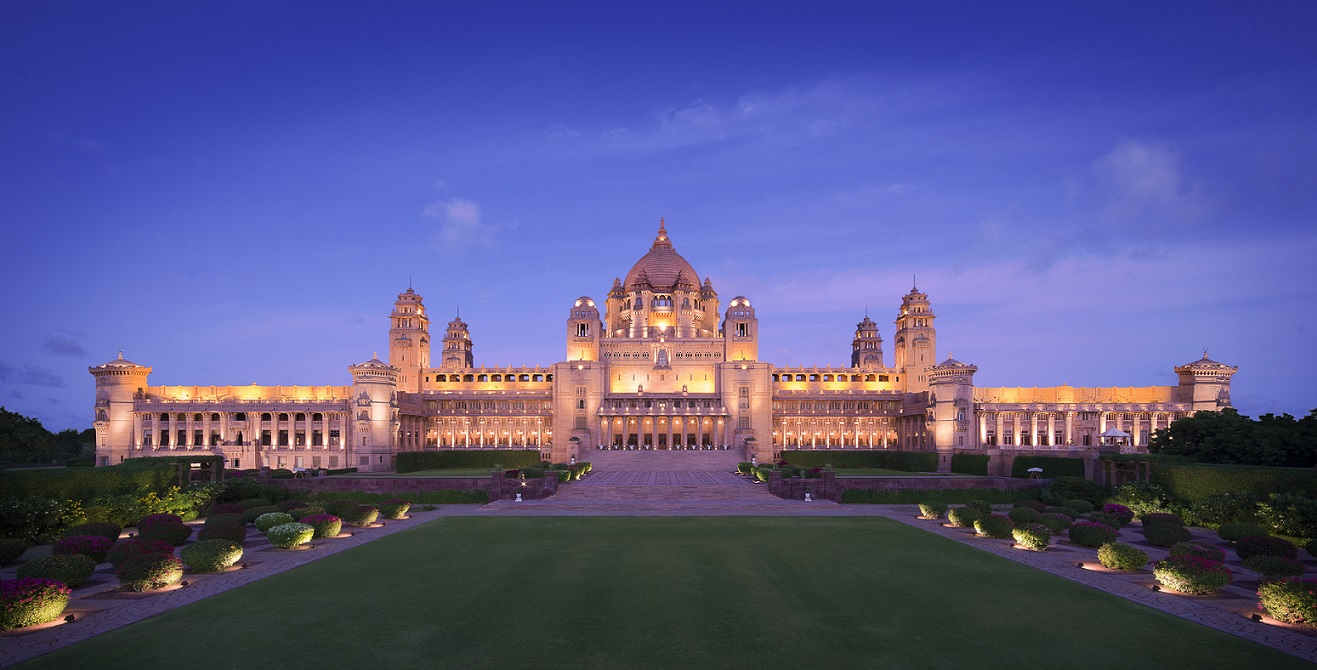
Umaid Bhawan Palace is the working palace of the Jodhpur royal family — designed by British architect Henry Vaughan Lanchester, built between 1929 and 1943 by Maharaja Umaid Singh as famine relief during a regional drought (the project employed up to three thousand people). At 347 rooms it remains the world's sixth-largest private residence, and one of the few palaces in India where the original royal family still lives in part of the building. Sixty-four guest rooms and suites occupy the hotel wing, with the Taj-signature subterranean zodiac pool beneath the central dome, fifteen acres of manicured gardens with views to Mehrangarh Fort, and a wood-panelled bar once cooled by ice poured into wall cavities. Asia's Best Classic 2015 winner.
 
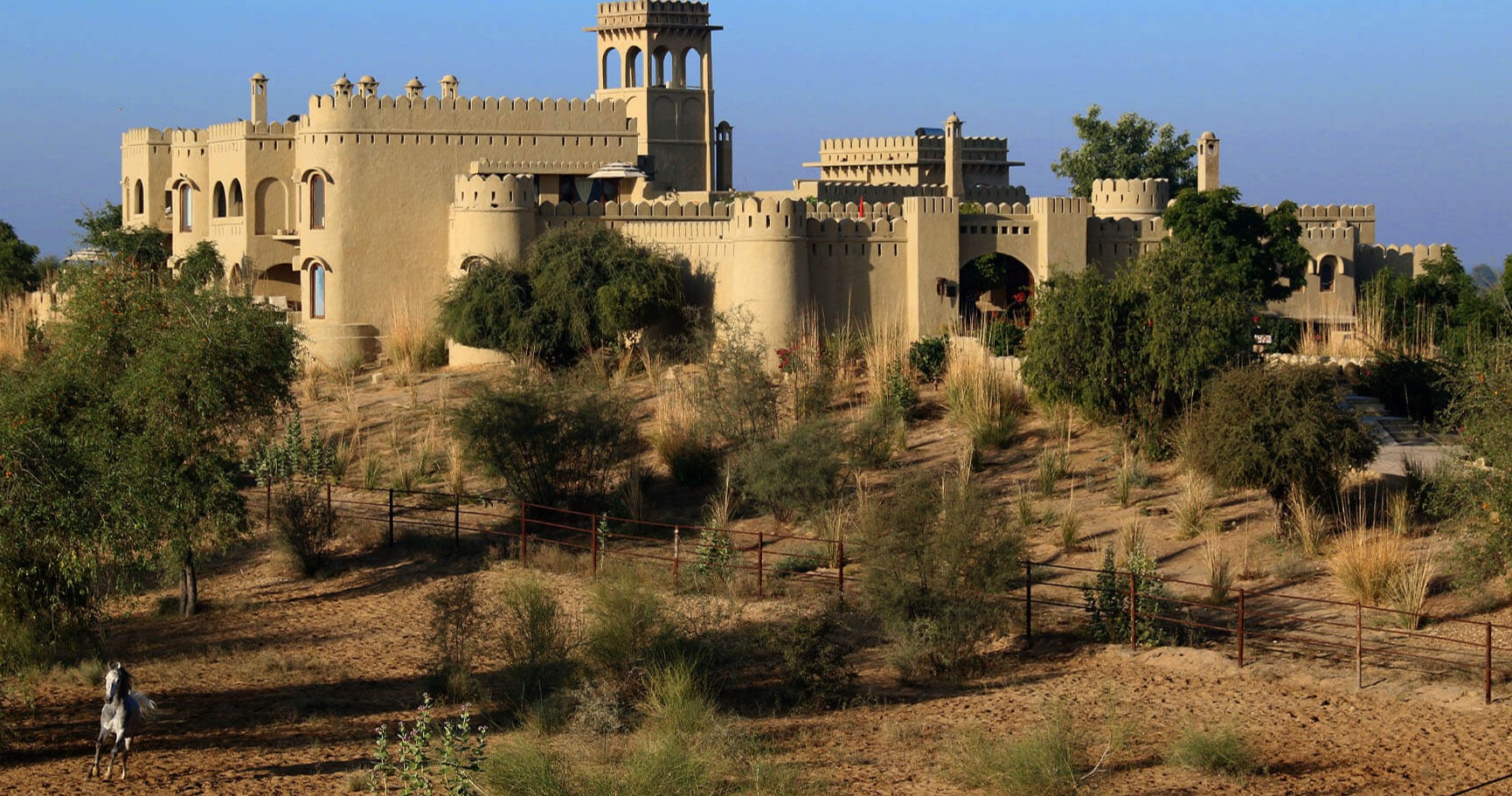
Mihir Garh sits forty-five minutes south of Jodhpur in the open Marwar desert — a nine-suite fortress built between 2007 and 2009 by Prince Siddharth and Rashmi Singh of Rohet, designed personally by the couple with over a hundred local artisans. The name means "Fort of the Sun" in Marwari. Each suite is over 1,700 square feet with a private plunge pool or Jacuzzi; the property runs Marwari horse safaris (the indigenous Indian breed, recognisable by inward-curving ear tips) and Bishnoi village excursions. Europe's Most Romantic Retreat 2013 winner.
 
Jaisalmer — the Golden City
Three hundred kilometres further west, on the old Silk Road trade route from Egypt and Persia to India. Jaisalmer is built entirely from local yellow sandstone, which catches the desert light and gives the city its name. The twelfth-century fort is one of the few in the world still inhabited (about a quarter of the old town's population lives within its walls), and the surrounding Thar dunes stretch from the city to the Pakistan border eighty kilometres west.
 
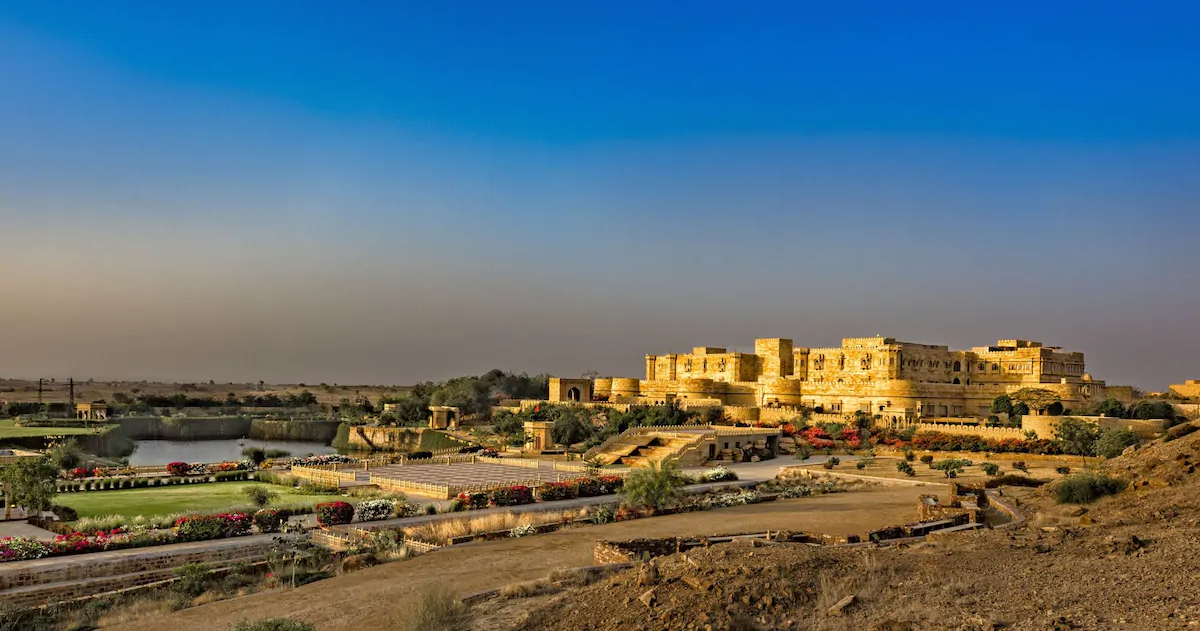
Suryagarh sits in the desert outside Jaisalmer — a contemporary sandstone fortress built by Manvendra Singh in the local interlocked-block construction style, with seventy-seven rooms across multiple courtyards. The estate runs desert excursions to the abandoned villages of the Paliwal Brahmins (depopulated in 1825 by mass migration), the Jazia oasis, and dune-edge picnics with Manganiyar folk musicians. The Rait Spa works with locally sourced spice rubs alongside French treatments. Asia's Best Culinary 2015 winner.
 
Members access exclusive rates not listed publicly or on any booking platform.

Browse on Map — Rajasthan

Explore 3 exceptional boutique hotels hand-picked in Rajasthan. Click a pin to discover each property.

Hotels in Rajasthan

Mihir Garh

India, Rajasthan

Mihir Garh

The epitome of romance: a dream spot for a proposal or to celebrate an anniversary

Umaid Bhawan Palace

India, Rajasthan

Umaid Bhawan Palace

Part royal residence and part luxury hotel, the Umaid Bhawan is a modern palace with an old world charm.


Suryagarh
Up To 12%

India, Rajasthan

Suryagarh

A poet’s muse disguised as an unreservedly opulent dream castle floating amidst the Thar Desert.

€120.90

Price for 1 night from

Rajasthan Guide

When to go
Royal forts, desert adventures, colorful culture, and timeless heritage in Rajasthan. 📍

When to go

Rajasthan has a sharp seasonal calendar that determines whether the trip works or not. October through March is the only sensible window for first-time visitors. The desert mornings are cool, the days dry, the air clear of dust. Rates are at their highest in November and the second half of December — Christmas and New Year at the heritage palaces book out a year ahead. February is the value sweet spot: weather still clean, rates eased after the holiday peak. Holi falls in March (variable date) and is worth planning around if you want the festival rather than wanting to avoid it.

April and May are brutal. Daytime highs of 42-45°C in Jaisalmer and Jodhpur, the desert essentially uninhabitable between noon and five. Hotel rates fall 50-70%; if your priority is the architecture rather than the desert excursions, the trade-off can work. June to September is monsoon — most rural and desert properties close entirely, lake-edge Udaipur is at its photogenic best but elsewhere the heat and humidity combine miserably.

The single sharpest seasonal point: tiger safaris at Ranthambore run only October to April. If wildlife matters, the trip dates are non-negotiable.

How to structure the trip

The four cities most visitors choose between are Jaipur, Udaipur, Jodhpur and Jaisalmer. A first-time Rajasthan trip rarely manages all four — the distances are deceptive and the travel days eat into the experience days.

Five days: Jaipur and Udaipur only. The minimum trip. Fly into Jaipur, two nights, drive or fly to Udaipur, three nights, fly home from Udaipur. You see the Pink City and the lake palaces and miss the desert entirely.

Eight to ten days: Jaipur, Udaipur, Jodhpur. The canonical first-time Rajasthan trip. Adds the Marwar — Mehrangarh Fort, the Bishnoi villages, and the first taste of desert. Jodhpur-Udaipur and Jaipur-Udaipur are both five-hour drives, so internal travel is real.

Twelve to fourteen days: add Jaisalmer. Three hundred kilometres further west than Jodhpur, deep into the Thar. The drive is five hours of empty desert highway; the overnight sleeper train from Jodhpur is the more atmospheric option. Jaisalmer rewards the journey — it's the closest thing in India to genuine remoteness — but isn't worth squeezing in shorter than three nights.

Internal logistics: private car with driver is the default for travellers staying at heritage properties; the cost difference versus self-drive is small and Indian highway driving is not a casual undertaking. Jaipur, Udaipur, Jodhpur and Jaisalmer all have domestic airports — flights between them are short and cheap, worth using if you want to skip a long road day.

Jodhpur and the Marwar

Jodhpur is Rajasthan's second-largest city, founded in 1459 by the Rathore clan as capital of the Marwar kingdom. Mehrangarh Fort dominates the skyline from a 125-metre rock above the old town — one of India's largest forts and unusually unmissed by tourists distracted by Jaipur or Udaipur. The fort museum is the best of its kind in the state. Below it, the blue-painted old town descends in tight lanes around the Clock Tower bazaar.

The indigo paint tradition: originally a Brahmin caste marker, then adopted city-wide partly because the lime-based pigment repelled mosquitoes and partly because the colour kept houses cooler under the desert sun. The result, viewed from Mehrangarh's ramparts, is the only city in India that looks the way Jodhpur looks.

The Marwar region opens west and south from the city. Forty-five minutes out, you're in open desert and Bishnoi country. The Bishnoi are India's original conservationists — an 18th-century Vaishnavite community whose 29 principles include the protection of trees and wildlife. In 1730 a group of 363 Bishnoi villagers were killed defending khejri trees from royal foresters. The term "tree-hugger" originates with this incident. Modern Bishnoi village excursions visit working communities that still observe the principles — temple visits, blackbuck antelope sightings, opium tea ceremonies (yes, legal here, by tradition).

Jaisalmer and the Thar Desert

Jaisalmer is the deepest western point most travellers reach — eighty kilometres from the Pakistan border, three hundred from Jodhpur, built entirely in honey-coloured local sandstone. The twelfth-century fort is one of the only inhabited forts left in the world, with around three thousand people still living within its walls. (This is a problem as much as a feature: drainage from inhabited fort buildings is causing structural damage to twelfth-century foundations. Stay in the fort if you want the experience; understand you're contributing to the issue.)

The old town below the fort is the better stay in any case — sandstone havelis (merchant mansions) with intricately carved jharokha screens, the legacy of Jaisalmer's role on the old silk-route caravan path from Egypt and Persia to Delhi. The Patwon Ki Haveli and Salim Singh Ki Haveli are the two worth a slow visit.

Outside the city, the abandoned Paliwal Brahmin villages — Kuldhara is the most famous — were depopulated overnight in 1825. Local lore says the villagers were cursed; historians suggest a tax dispute with the Jaisalmer state. The buildings still stand, eerie and intact.

The Thar dunes proper are forty-five minutes west toward Sam. Day-trip camel safaris from the city are tourist-trap territory; for the real experience, stay overnight at a desert camp or take a multi-day expedition with a private guide. The Manganiyar — hereditary Muslim folk musicians of the desert — perform at sunset across the region. Their music is the best of any folk tradition in India.

What to eat

Rajasthani cuisine evolved in conditions that shape it visibly: pre-refrigeration desert, limited vegetables, ferocious heat. The result is one of India's most distinctive regional kitchens.

Dal baati churma is the canonical Marwari trio — slow-cooked lentil curry, baked wheat balls broken open and drowned in ghee, sweetened wheat crumble for the third element. The original road food, designed to keep in desert heat. Order it at least once.

Laal maas is the regional red mutton curry. Cooked with Mathania chillies (a local variety) and yoghurt, no tomato, brutally hot by Western standards. Marwari kings used hunting parties as their excuse to commission it.

Gatte ki sabzi — chickpea-flour dumplings simmered in spiced yoghurt gravy. The vegetarian classic, found in every household kitchen.

Ker sangri — and this one matters. Desert berries (ker) and beans from the khejri tree (sangri), sun-dried and rehydrated, cooked with mustard oil and spices. Unique to Rajasthan; you won't find it elsewhere in India. If you eat one regional dish on the trip, eat this.

Mawa kachori — Jodhpur's sweet pastry stuffed with reduced milk solids, deep-fried, drenched in sugar syrup. Local breakfast or post-lunch indulgence.

For the highest-end version of all of this: the Risala restaurant at Umaid Bhawan Palace (Jodhpur) and the courtyards at Suryagarh (Jaisalmer) — Asia's Best Culinary 2015 winner. The cooking at both is regional Rajasthani done at the level it deserves, which is rare even within Rajasthan.

What's worth doing — and what to skip

Bishnoi village safari from Jodhpur or Mihir Garh — the strongest single experience the Marwar offers, and the only way to encounter India's oldest conservation community on their own terms.

Manganiyar music at sunset, anywhere in the western desert — particularly the Suryagarh courtyard performances. The hereditary musicians are the genuine article, not a tourist routine.

The abandoned Paliwal villages outside Jaisalmer (Kuldhara especially) — twenty minutes from the city, free, and unlike anywhere else in India.

Ranthambore tiger safaris — but only with a serious booking lead time (three to six months ahead), only in season (October-April), and only if you accept that big-cat sightings are never guaranteed. The park has roughly 75 tigers; the morning safari is the better odds.

Private dinner on the Mehrangarh ramparts — the fort opens for arranged private hire after closing. The best meal in Jodhpur happens fifteen metres above the blue city.

Worth skipping:

The Pushkar Camel Festival — heavily commercialised since the early 2000s, more tourist showcase than working livestock fair. The everyday Pushkar markets are more authentic than the November festival.

Jaipur block-print "factory tours" — most are commission-driven retail traps. Buying directly from artisan workshops in Bagru (an hour outside the city) is the better route, ask your hotel for an introduction rather than booking through a tour operator.

Elephant rides at Amber Fort — animal welfare concerns are increasingly well-documented; the elephants work in temperatures and on terrain unsuited to the species. The fort is more enjoyable on foot anyway. PETA India's campaign on this is worth reading.

The standard "Pink City walking tour" — repetitive across providers, weighted heavily toward shop stops. Hire a private guide through your hotel instead.

Icon of Here for You
Here for You
Icon of Free Extras on Arrival
Free Extras on Arrival
Icon of Best Price Guarantee
Best Price Guarantee
Icon of Personally Approved Hotels
Personally Approved Hotels
Icon of Exclusive Offers
Exclusive Offers
Icon of New Finds Every Month
New Finds Every Month