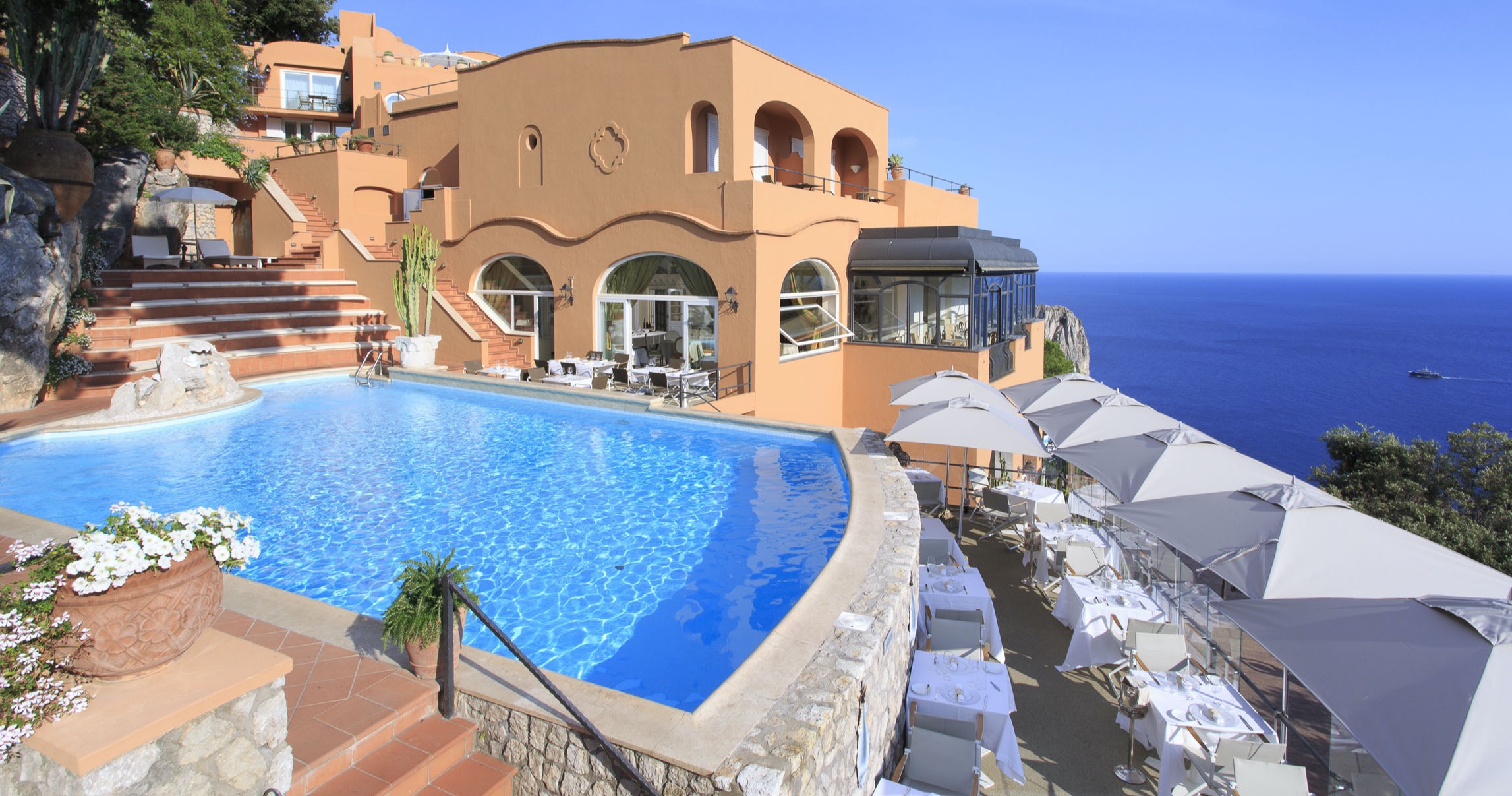
Capri is a four-square-mile slab of limestone rising sheer from the Bay of Naples — a separate trip from the mainland Amalfi Coast despite the visual rhyme, with its own ferries from Naples and Sorrento and its own seasonal pulse. It has been a place of glorious retreat for two thousand years: Tiberius ruled the empire from Villa Jovis on the eastern cliff, and Augustus before him called the island Apragopolis — the city of doing nothing. The writers followed and never really stopped; Norman Douglas, Compton Mackenzie, Rilke, Neruda and Graham Greene all worked from versions of the same terrace above the same rocks.
The island divides cleanly in two. Capri town fills the saddle between the limestone peaks and carries the glamour; Anacapri, on the upper plateau, is the older, whitewashed, quieter half. Around the edges lie the set pieces — the Faraglioni stacks off the eastern point, the Blue Grotto on the northwest coast, the swimming coves of Marina Piccola to the south.
What changes everything is the boat schedule. In season the island absorbs thousands of day-trippers between mid-morning and five o'clock; when the last ferries pull out, Capri returns to itself, and the evening — the Piazzetta lit, the lanes emptied, the rocks going dark offshore — belongs to the people who stayed. Staying is the point.