Destination, hotel name or experience

Boutique Hotels in Espoo

Introducing Espoo

Espoo is Finland's second-largest city by population, the western neighbour of Helsinki and the unusual case of a European capital-region city that is more forest than urban. The city has no single centre; instead five separate district hubs (Leppävaara, Tapiola, Matinkylä, Espoon keskus and Espoonlahti) each carry their own civic infrastructure, with a 58-kilometre Baltic coastline to the south, ninety-five lakes spread across the city area, and 53 km² of Nuuksio National Park forming the northern third of the municipality. The pattern reflects Espoo's history rather than a planning choice — the city grew rapidly from a rural Swedish-speaking parish into a Helsinki-overflow housing zone from the 1950s onwards, with the Tapiola garden city as the showpiece mid-century urban-planning experiment. Aalto University's Otaniemi campus, the headquarters of Nokia, KONE, Neste and Rovio, and a substantial Finnish design and technology sector all sit within the city's borders.


What gives Espoo its character as a destination is the proximity ratio: a major Finnish national park, the Akseli Gallen-Kallela art museum at Tarvaspää, the EMMA Museum of Modern Art at the WeeGee house, the Espoon kartano manor (first mentioned in records in 1495), and a substantial coastline are all reachable within 30 to 45 minutes of Helsinki-Vantaa Airport. The signature wildlife species is the Siberian flying squirrel, the city's official animal, with one of Finland's densest populations in Nuuksio National Park.

Browse on Map — Espoo

Explore 1 exceptional boutique hotel hand-picked in Espoo. Click a pin to discover each property.

Hotels in Espoo

Haltia Lake Lodge

Finland, Espoo

Haltia Lake Lodge

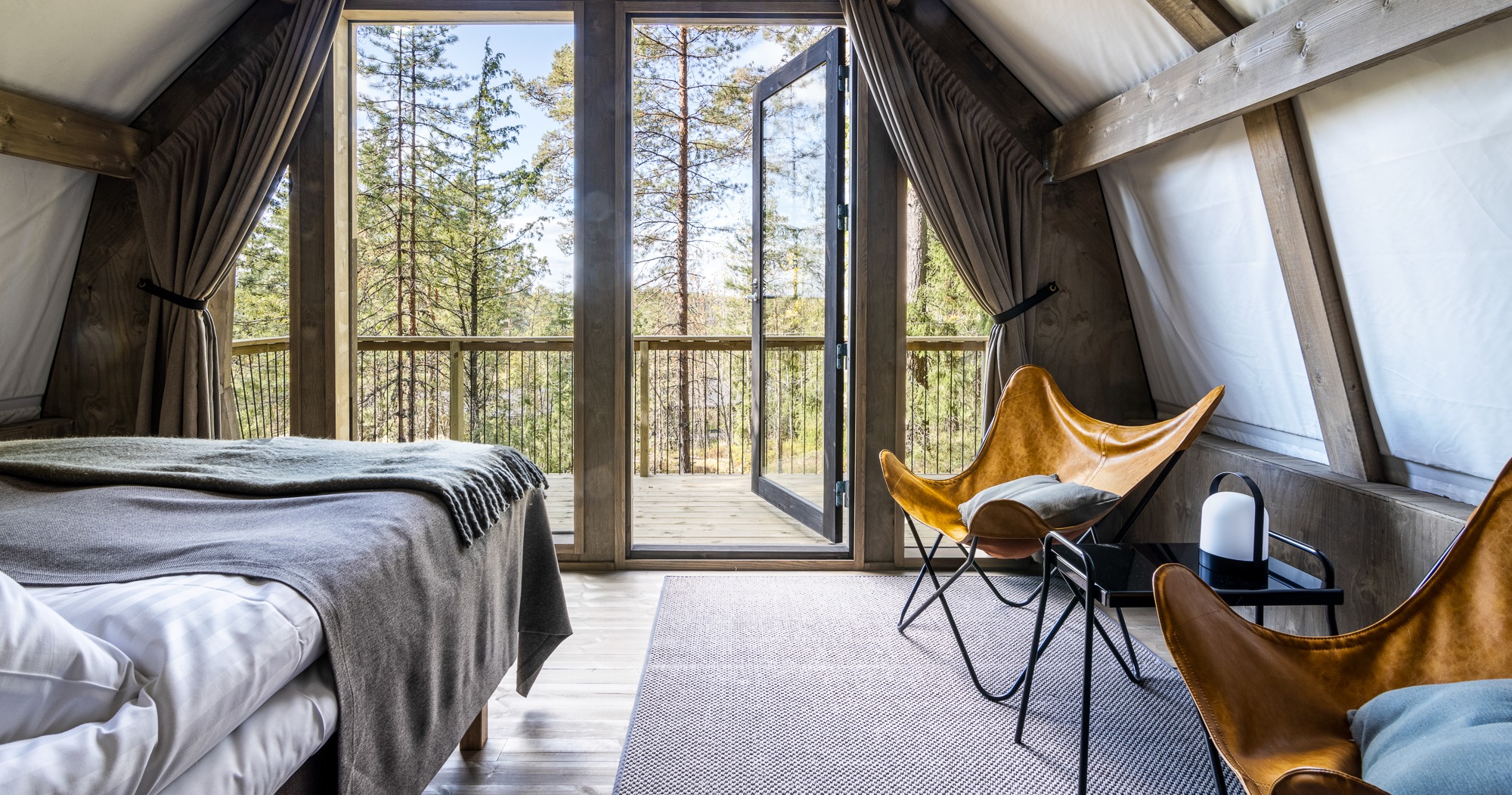
A nature lodge on Lake Pitkäjärvi inside Nuuksio National Park, 35 minutes from Helsinki — 20 boutique rooms plus 5 glamping tents…

Espoo Guide

Nuuksio National Park
Falun-red Nordic timber facade of Haltia Lake Lodge with outdoor dining terrace, Espoo, Finland 📍

Nuuksio National Park

Nuuksio sits at Espoo's northern edge, established as a national park in 1994 and now covering 53 km² across Espoo, Kirkkonummi and Vihti. The landscape is rocky hill upland shaped by the last Ice Age — barren lichen-covered ridges, spruce-dominated old-growth forest under the cliffs, more than eighty small lakes and ponds, and the highest point at Mustakorvenkallio at 114 metres. The park is one of the densest Siberian flying squirrel habitats in Finland; the species is its emblem. The 8 marked hiking trails run from 1.5 km to 17 km, and the Finnish Nature Centre Haltia next to the park entrance has run exhibitions on Finnish nature and biodiversity since 2013. Haltia Lake Lodge sits on Lake Pitkäjärvi inside the park — a hybrid 20-room boutique hotel and 5-tent glamping resort founded by Teemu Tuomarla, with the 2025 Maisemakammi Scenic Hut (architect Malin Moisio) as its latest addition.

Tapiola and the urban Espoo

The southern half of Espoo runs as a polycentric urban-suburban zone along the Helsinki commuter belt. Tapiola, the 1950s garden-city quarter designed as a mid-century urban-planning showcase, holds the Espoo Cultural Centre (home of the Tapiola Sinfonietta orchestra), the EMMA Museum of Modern Art at the WeeGee house (a converted printing works), and the city's most architecturally interesting concentration. Otaniemi to the east holds Aalto University and the substantial technology-startup ecosystem around it. The Akseli Gallen-Kallela Museum at Tarvaspää sits in the artist's purpose-built studio-house from 1913, on a wooded peninsula reachable from central Helsinki by ferry in summer. The coastline runs the full southern edge of the city — 58 km of Baltic shore with 165 islands offshore, the Espoon kartano manor at the western end first mentioned in 1495, and the Suomenoja Bird Reserve as a smaller wildlife enclave inside the urban zone.

When to visit

Espoo runs four genuine seasons, each delivering a different version of the destination. Spring (April–May) is when the Nuuksio wood anemones turn the forest floor blue and white, the flying squirrels are most active, and the day length stretches rapidly toward summer. Summer (June–August) is the peak: daylight running close to 19 hours by midsummer, lake-swimming temperatures from late June, the full hiking and cycling season in Nuuksio, and the festival calendar in Tapiola (Espoo Ciné film festival, April Jazz). Autumn (September–October) is the editorial sweet spot — Nuuksio's mixed forests turning yellow and red, the cultural calendar back to full programming in the city centres, and the visitor numbers thinned out. Winter (December–March) is cold and snowbound: cross-country ski tracks through Nuuksio (the 3 km track at Haltia is floodlit), the Tapiola Ice Park's 330-metre circular skating track, and snowshoe hiking on the same trails the summer hikers use. Snow first falls after Christmas and typically melts late March to early April.

Frequently Asked Questions about Espoo

Icon of Here for You
Here for You
Icon of Free Extras on Arrival
Free Extras on Arrival
Icon of Best Price Guarantee
Best Price Guarantee
Icon of Personally Approved Hotels
Personally Approved Hotels
Icon of Exclusive Offers
Exclusive Offers
Icon of New Finds Every Month
New Finds Every Month