Destination, hotel name or experience

Boutique Hotels in Rovaniemi

Introducing Rovaniemi

Rovaniemi sits on the Arctic Circle at the confluence of the Kemijoki and Ounasjoki rivers, the administrative capital of Finnish Lapland. The city's defining historical event was its destruction in October 1944, when retreating German forces burned 90% of its buildings during the Lapland War; the post-war rebuild gave Rovaniemi a more distinctive architectural identity than most Finnish cities. Alvar Aalto designed the urban plan as an aerial view of a reindeer's head and antlers, with the local football stadium forming the eye. Ferdinand Salokangas, Aalto's contemporary, designed the major public buildings of the reconstruction era — the Fire Station, the Kauppalantalo (Market Town Hall, now Arctic Light Hotel), and much of the city's other administrative architecture. Most of what visitors see in central Rovaniemi today is mid-20th-century functionalist work rather than pre-war heritage.


What draws visitors beyond regional administration is the city's position. The Arctic Circle runs through the northern edge of Rovaniemi, with Santa Claus Village sitting directly on the line as the destination's most-visited single attraction. The city is the southern gateway to Finnish Lapland — flights from Helsinki and several European hubs land at Rovaniemi Airport (RVN) eight kilometres north of the centre, with onward transfers to the wilderness lodges of central Lapland and to the Arctic wilderness of Pallas-Yllästunturi National Park two hours' drive north. The Aurora Borealis is reliably visible from late August to late March on clear nights; the midnight sun runs from early June to early July.

Browse on Map — Rovaniemi

Explore 1 exceptional boutique hotel hand-picked in Rovaniemi. Click a pin to discover each property.

Hotels in Rovaniemi

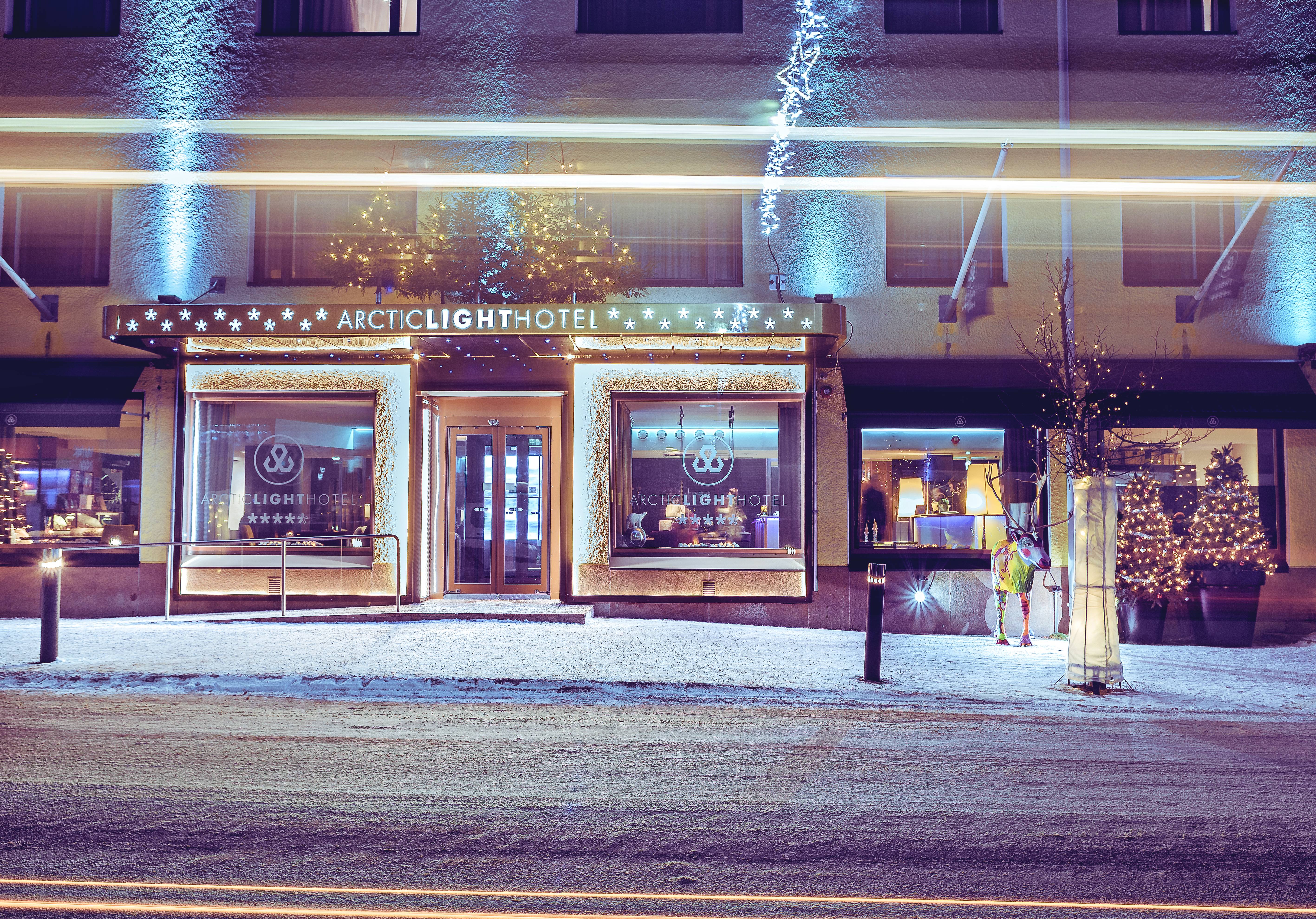
Arctic Light Hotel

Finland, Rovaniemi

Arctic Light

The 1949 former Kauppalantalo of Rovaniemi, redeveloped by the Gröhn family in 2015 as a 57-room boutique hotel — Paavo Tynell lighting…

€135.30

Price for 1 night from

Rovaniemi Guide

City Centre
Glass-enclosed Arctic Winter Garden at Arctic Light Hotel, a lounge space on the courtyard side of the 1949 Kauppalantalo 📍

City Centre

The Rovaniemi city centre runs in a compact grid south of the Kemijoki river crossing, on the streets that Alvar Aalto's reindeer-head plan organises. The Korundi House of Culture — converted from the 1933 post bus depot, one of the few buildings to survive the 1944 destruction — holds the Rovaniemi Art Museum collection and a concert hall used by the Chamber Orchestra of Lapland. The Arktikum Museum and Arctic Science Centre sits at the city's northern edge in a striking glass-tube building by Danish architects Birch-Bonderup & Thorup-Waade, opened on 6 December 1992 for the 75th anniversary of Finland's independence; the glass tube is conceived as a "frozen finger of the north" pointing toward the Arctic. The Kauppalantalo on Valtakatu, Salokangas's 1949 Market Town Hall, has operated since 2015 as Arctic Light Hotel — a family-run 57-room boutique hotel with Paavo Tynell lighting preserved in the former city council meeting room and a starred-balcony façade lit at night.

Santa Claus Village

Santa Claus Village sits eight kilometres north of central Rovaniemi, on the line of the Arctic Circle. The complex is more than the obvious Santa Claus office and post office — it is a developed visitor precinct including SantaPark (an underground theme experience), husky and reindeer cart routes, and a cluster of cafés and shops. The Arctic Circle line is marked across the village floor and a substantial part of the visit involves crossing it for the photograph. The village runs year-round with seasonal activity adjustments and is at its calendar peak from mid-November through early January, when Christmas atmosphere is at its most concentrated. The 15-minute drive from the city centre runs along the Ounaskoski rapids on the airport road.

When to visit

Where is Salzburger Land?

The state of Salzburg, in central-western Austria, bordering Tyrol to the west, Bavaria and Upper Austria to the north, Styria to the east, and Carinthia to the south. The capital is the city of Salzburg. The state is roughly 7,150 km², dominated by Alpine terrain in the south (the Pinzgau and Pongau districts) and lower terrain in the north (the Salzkammergut lake district straddles the border with Upper Austria).

How do I get to Leogang?

Salzburg Airport (SZG) is the closest international hub, around 75 minutes by car. Munich Airport (MUC) is roughly 2.5 hours by car. Innsbruck Airport (INN) is around 90 minutes. The ÖBB rail network reaches Saalfelden (10 minutes from Leogang by transfer), Leogang's own station (Bahnhof Leogang), and Fieberbrunn. Many BHC properties provide free transfers from the local stations. By car, Leogang is on the B164 road between Saalfelden and Lofer in the Pinzgau valley.

Saalbach versus Leogang — which to stay in?

Saalbach-Hinterglemm is the larger, louder, more après-ski-oriented end of the same connected ski area. Leogang is the quieter Pinzgau-village end, with the family-friendly Asitz mountain base and a working-farm character that Saalbach-Hinterglemm has built away from. For party-ski culture, Saalbach. For a quieter base on the same lift network, Leogang.

Is Leogang worth visiting in summer?

Yes, increasingly so. The Asitz bike park is one of Europe's most developed mountain biking destinations, the UCI Mountain Bike World Cup downhill round comes to Leogang annually, and the alpine hiking on the Asitz and into the Leoganger Steinberge gives substantial summer terrain at altitude. The agricultural character of the valley floor is most legible in summer — working alms, cattle on the slopes, mountain herbs in bloom.


Frequently Asked Questions about Rovaniemi

Icon of Here for You
Here for You
Icon of Free Extras on Arrival
Free Extras on Arrival
Icon of Best Price Guarantee
Best Price Guarantee
Icon of Personally Approved Hotels
Personally Approved Hotels
Icon of Exclusive Offers
Exclusive Offers
Icon of New Finds Every Month
New Finds Every Month