Destination, hotel name or experience

Boutique Hotels in Mdina

Introducing Mdina

Mdina is the town Malta keeps quiet about, which is fitting, because its other name is the Silent City. Set on a hill in the centre of the island, walled and gated, it was Malta's capital for the better part of two thousand years — Phoenician, Roman, Arab and Norman in turn — long before the Knights of St John arrived and built Valletta down on the coast. They renamed it the Città Notabile, the Noble City, fortified its bastions and filled it with palazzi, and then largely left it to the old aristocratic families who had always lived there. They live there still.


That is what makes Mdina unlike anywhere else on Malta. It is tiny — a few hundred residents inside the walls, almost no cars, a single main gate — and by day it fills with visitors come to see the cathedral, the bastion views and the honey-coloured Baroque streets that have stood in for King's Landing and a dozen other screen cities. But the visitors leave at dusk, and the gates empty, and Mdina becomes genuinely silent: lamplit, deserted, medieval. The town repays the few who stay the night more than almost any place in the Mediterranean.

Browse on Map — Mdina

Explore 1 exceptional boutique hotel hand-picked in Mdina. Click a pin to discover each property.

Hotels in Mdina

1

Malta, Mdina

The Xara Palace Relais & Chateaux

The only hotel within the walls of Mdina, Malta's Silent City — a restored 17th-century noble palazzo of seventeen rooms, with a starred…

Mdina Guide

Within the walls: the Silent City

Mdina is small enough to cross in fifteen minutes and rich enough to fill a day. Enter through the Main Gate — the grand Baroque one made familiar by film — and the noise of the island falls away. The centrepiece is St Paul's Cathedral, built where, by tradition, the Roman governor Publius met the shipwrecked St Paul; its Baroque interior and the adjoining cathedral museum reward a slow look. Beyond it, the pleasure is simply the streets: narrow, shaded, lined with the carved doorways and corner shrines of palazzi still in private hands, opening without warning onto the bastions.


The bastion walls are the other great draw — a walk along the ramparts gives views across half of Malta, to Mdina's sister-suburb Rabat below, the central plain, and the distant sea and Valletta. Palazzo Falson and the Palazzo de Piro give a sense of the patrician interiors; the small cafes and the famous orange-and-chocolate at Fontanella on the wall are the traditional pause. Just outside the gate, Rabat continues the story: the catacombs of St Paul and St Agatha, and the grotto where the saint is said to have sheltered, all within a short walk.

Where to stay, and the island beyond
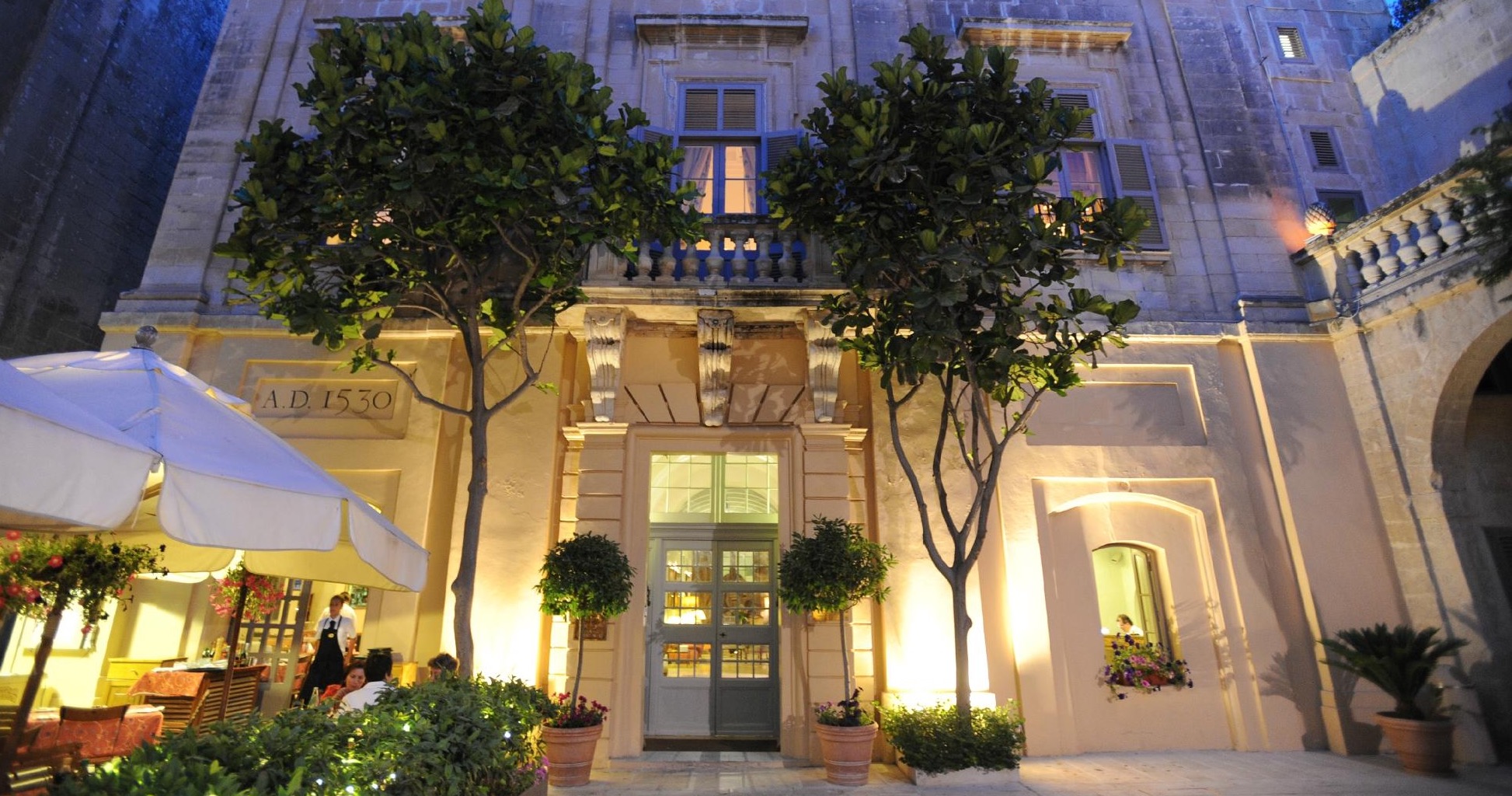
Outdoor courtyard restaurant with bistro tables before a honey-gold Baroque palazzo facade in Mdina 📍

Where to stay, and the island beyond

Mdina's appeal as a base is precisely its quiet — and the rare experience of having a walled medieval city to yourself once the day-trippers have gone. Staying inside the walls is the thing to do if you can: The Xara Palace, a restored seventeenth-century noble palazzo on the bastions, is the only hotel within Mdina itself, and home to the island's most celebrated fine-dining room on its ramparts. Rabat, immediately outside, offers a gentler, more local alternative, and the resort coast and Valletta are both well within reach.


Mdina's central position makes it an unusually good launch point for the rest of Malta. Valletta and its harbour are about twenty-five minutes away; the megalithic temples of the south, the fishing village of Marsaxlokk, and the cliffs of Dingli are all short drives; and the ferry to Gozo, the quieter sister island, is reachable for a day or an overnight. The island is small — nowhere is much more than an hour off — so Mdina works as well for exploring as for retreating.

When to visit Mdina

Spring and autumn — roughly April to June, and September to early November — are the best times, with warm days, manageable crowds and the island at its greenest in spring. High summer is hot and busy, and Mdina's daytime visitor numbers peak then, though the evenings inside the walls stay cool and calm whatever the season. Winter is mild, quiet and atmospheric, with the lowest crowds and the occasional grey day; the city's stone and its silence suit it well. Whenever you come, the trick is the same: see Mdina early or late, and let the middle of the day, when the tour groups arrive, be the time you spend elsewhere on the island.

Frequently Asked Questions about Mdina

Icon of Here for You
Here for You
Icon of Free Extras on Arrival
Free Extras on Arrival
Icon of Best Price Guarantee
Best Price Guarantee
Icon of Personally Approved Hotels
Personally Approved Hotels
Icon of Exclusive Offers
Exclusive Offers
Icon of New Finds Every Month
New Finds Every Month