

€185.00 for 1 Night





24/7 Support
 Looking for help choosing or for a property we don't list? Message our Private Rates Concierge on WhatsApp for member rates and insider knowledge on the right stay
Schlosshotel Kronberg
€185.00/ Night
24/7 Support
Looking for help choosing or for a property we don't list? Message our Private Rates Concierge on WhatsApp for member rates and insider knowledge on the right stay
Schlosshotel Kronberg — 60 rooms in the 1893 royal castle built by Empress Victoria (Queen Victoria's eldest daughter), House of Hesse-owned, 15 min from Frankfurt.
Collections:
Award Winner 2015
Europe’s Best Classic Hotel
Need To Know
- 60 rooms and suites across the 1889-1893 castle — Heritage Rooms, Castle Rooms, Park View / Grand Park View categories, Junior Suites and Royal Suite. Privately owned by the House of Hesse; current head Donatus Landgrave of Hesse, Empress Victoria's great-grandson
- Restaurant Victoria in Empress Victoria's original dining room — Castle Lunch (Wed-Sun 12:00-14:00) and Fine Dine Dinner (Wed-Sun 18:00-22:00, 3 / 4 / 5 / 6-course menus). German and Italian classics with Prinz von Hessen Rheingau wines from the family's own vineyard
- Jimmy's Bar — whiskies, cigars, live piano accompaniment
- Eisenhower's 18-hole golf course — designed by Dwight D. Eisenhower during his 1946-1953 residency at the castle as Supreme Allied Commander
- Five historic event spaces — Roter Salon (105 m², 60 pax), Grüner Salon (126 m², 120 pax), Blauer Salon (38 m², 16 pax), Kleiner Speisesaal (46 m², 25 pax) and the Bibliothek library (72 m², 60 pax). Both civil and private weddings on the rotunda or in the library
- Recurring events programme: English Afternoon Tea (continuing Empress Victoria's tradition), monthly castle tours, Champagne Sunday, Picnic in the Park, Theatre on the Rotunda (Shakespearean), Mother's Day Brunch, Summer BBQ
- 58 hectares of castle parkland; horseback riding; bicycles; concierge
Check in - Check out
Check in from 14:00; check out before 12:00.
We Love
- The royal architectural inheritance — designed by Ernst von Ihne, the royal architect to Friedrich III and Kaiser Wilhelm II, combining German and Italian Renaissance with English Tudor Gothic and Hesse-Franconian timber framing.
- The Empress Victoria heritage — Queen Victoria's eldest daughter built the castle for her widowhood in memory of Friedrich III ("the 99-day Emperor"). The "FRIDERICI MEMORIAE" inscription above the main portal remains in place.
- The art and antique inventory — original paintings by Frans Hals, Rubens, Titian and Gainsborough; Limoges porcelain, gilded Venetian mirrors, antique bronzes and ivories, stained glass with the Empress's family coats of arms.
- The Eisenhower golf course — designed by Dwight D. Eisenhower during his 1946-1953 residency at the castle as Supreme Allied Commander. Operational across the 58-hectare estate as one of the area's principal courses.
- The House of Hesse private ownership — owned by Donatus Landgrave of Hesse, great-grandson of Empress Victoria, great-great-grandson of Queen Victoria, great-grandson of King Victor Emmanuel III of Italy.
- The Prinz von Hessen wine programme — Riesling and Pinot Noir from the House of Hesse's Rheingau vineyard estate, listed alongside the European cellar throughout Restaurant Victoria.
Key Features











Book Your Stay at Schlosshotel Kronberg
€185.00 for 1 Night
Location
Address
Hainstrasse 25, Kronberg, 61476, Germany
Travel Info
Frankfurt Airport (FRA) 30 min by car / 27 km; central Frankfurt 15 min by car. Kronberg station 5 min by car (S-Bahn line S4 connects directly from Frankfurt Hauptbahnhof in 30 min). 58 hectares of estate parking. Climatic-health-resort designation for air and water quality.
Nearby Places
Located approximately 25 minutes from Frankfurt Airport.
27km
Last Updated: 2026-05-21

Expert Review
Origins
Schlosshotel Kronberg was built between 1889 and 1893 as Schloss Friedrichshof — the dowager residence commissioned by Empress Victoria, eldest daughter of Queen Victoria of the United Kingdom, in memory of her husband Emperor Friedrich III (the "99-day Emperor" who ruled the German Empire for only ninety-nine days in 1888 before dying of throat cancer). The dedication "FRIDERICI MEMORIAE" ("To the memory of Friedrich") was inscribed above the main portal where it remains today. Ernst von Ihne — the royal architect to Friedrich III and Kaiser Wilhelm II, who designed many of the principal royal residences of late-imperial Germany and Austria — combined German and Italian Renaissance with English Tudor Gothic and Hesse-Franconian timber framing across the castle's exterior.
The Empress purchased approximately 100 acres of land in 1888 from the heirs of the Frankfurt financier Jacques Reiss; the surrounding estate has since grown to 58 hectares. After Empress Victoria's death in 1901 the castle was inherited by her youngest daughter, Princess Margaret of Prussia, Landgravine of Hesse, and has remained in the House of Hesse's private ownership for over a century. The contemporary head of the House — Donatus Landgrave of Hesse, the Empress's great-grandson and Queen Victoria's great-great-grandson — manages the property today through the Hessische Hausstiftung. The castle opened as a hotel in 1954 — seventy years of continuous operation under the family's ownership.
Top Secret
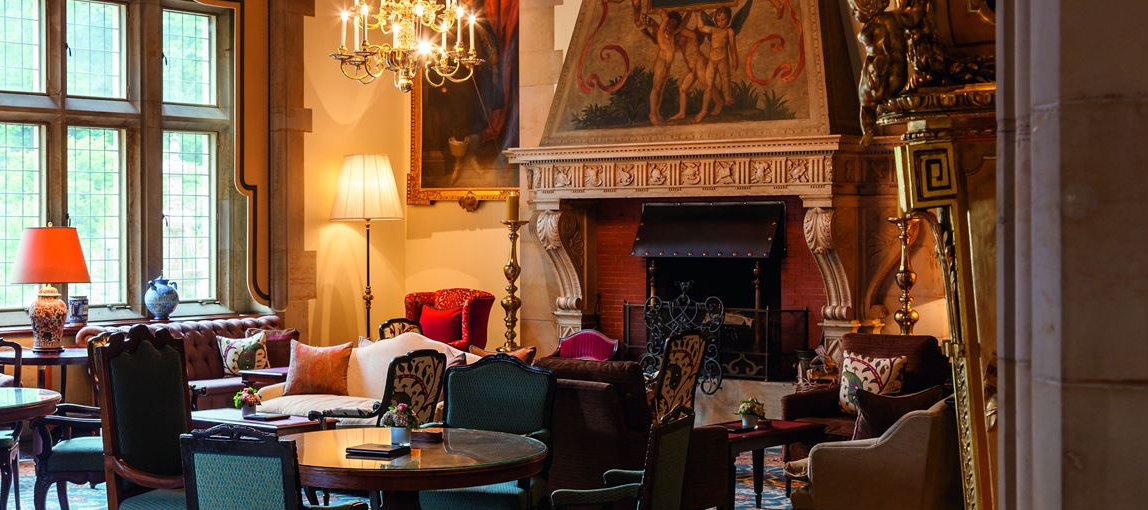
Beyond the public reception rooms, the castle's interior carries one of the great surviving collections of late-19th-century imperial taste in continental Europe: original paintings by Frans Hals, Rubens, Titian and Gainsborough; Limoges porcelain; gilded Venetian mirrors; antique bronzes and ivories; drinking vessels decorated with semi-precious stones; jewels, clocks, watches, coins and medals from the Empress's personal collections. The principal staircase is framed by stained glass carrying the coats of arms of Empress Victoria and her family — a visual record of the connected royal houses of late-19th-century Europe in glass form. Notable historical guests: Queen Victoria stayed at the castle during her visits to her daughter; Tsar Nicholas II of Russia also visited during the years of the Empress's residence. After WWII the castle housed Dwight D. Eisenhower as Supreme Allied Commander in Europe (1946-1953+) — during his residency Eisenhower designed and laid out the 18-hole golf course that operates today across the estate.
The Review
Schlosshotel Kronberg sits above the small Taunus town of Kronberg im Taunus in the German state of Hesse, fifteen minutes by car from central Frankfurt am Main and thirty from Frankfurt Airport. The position is unusually well-resolved for an urban-adjacent castle hotel: the climatic-health-resort designation for Kronberg's air and water quality reflects the genuine character of the surrounding Taunus hills, and the 58-hectare estate runs the property at a deliberately removed distance from the city below. The 13th-century medieval fortress Schloss Kronberg sits on an adjacent hill across the park valley — an entirely separate, older castle, not to be confused with the late-19th-century Schloss Friedrichshof that became the hotel.
The castle itself is the editorial centre of the property. Ernst von Ihne's 1889-1893 architectural composition combines German Renaissance ashlar stone work on the principal façade, with the service wing carrying Hesse-Franconian half-timbered upper storeys and attic cross-gables in the regional timber-framing tradition. The English Tudor Gothic and Italian Renaissance registers run through the interior detailing. The principal portal carries the "FRIDERICI MEMORIAE" dedication. The English Hall handles the main reception and distribution function inside; the broad staircase leads to the upper-floor reception rooms and the suites that were once occupied by the Empress and her guests. The original ground-floor program (drawing room, library, dining room, kitchen, entertainment room) sits in essentially the same configuration today, with the dining room of 1893 now operating as Restaurant Victoria — the property's gastronomic anchor.
The art and antique inventory is the property's editorial differentiator. Original paintings by Frans Hals, Rubens, Titian and Gainsborough sit on the walls of the reception rooms; the Empress's collection of Limoges porcelain, gilded Venetian mirrors, antique bronzes and ivories runs across the public spaces; the stained glass carrying the coats of arms of Empress Victoria and her connected royal houses frames the staircase. Drinking vessels decorated with semi-precious stones, jewels, clocks, watches, coins and medals from the Empress's personal collections complete the visible inventory. Few European hotels of any kind operate with this density of original royal-period decorative arts on display.
The 60 rooms and suites distribute across the castle and its connected wings. Heritage Rooms and Heritage Suites carry the original interior register; Castle Rooms, Castle Balcony Suites, Castle Grand Balcony Rooms, Castle Grand Parkview Rooms, Castle Parkview Rooms, Castle Grand Suites and Castle Junior Suites run across the broader inventory; the Royal Suite carries the top of the room hierarchy. Configurations include full-double, king-size, and twin layouts; refundable and non-refundable rates available across the inventory.
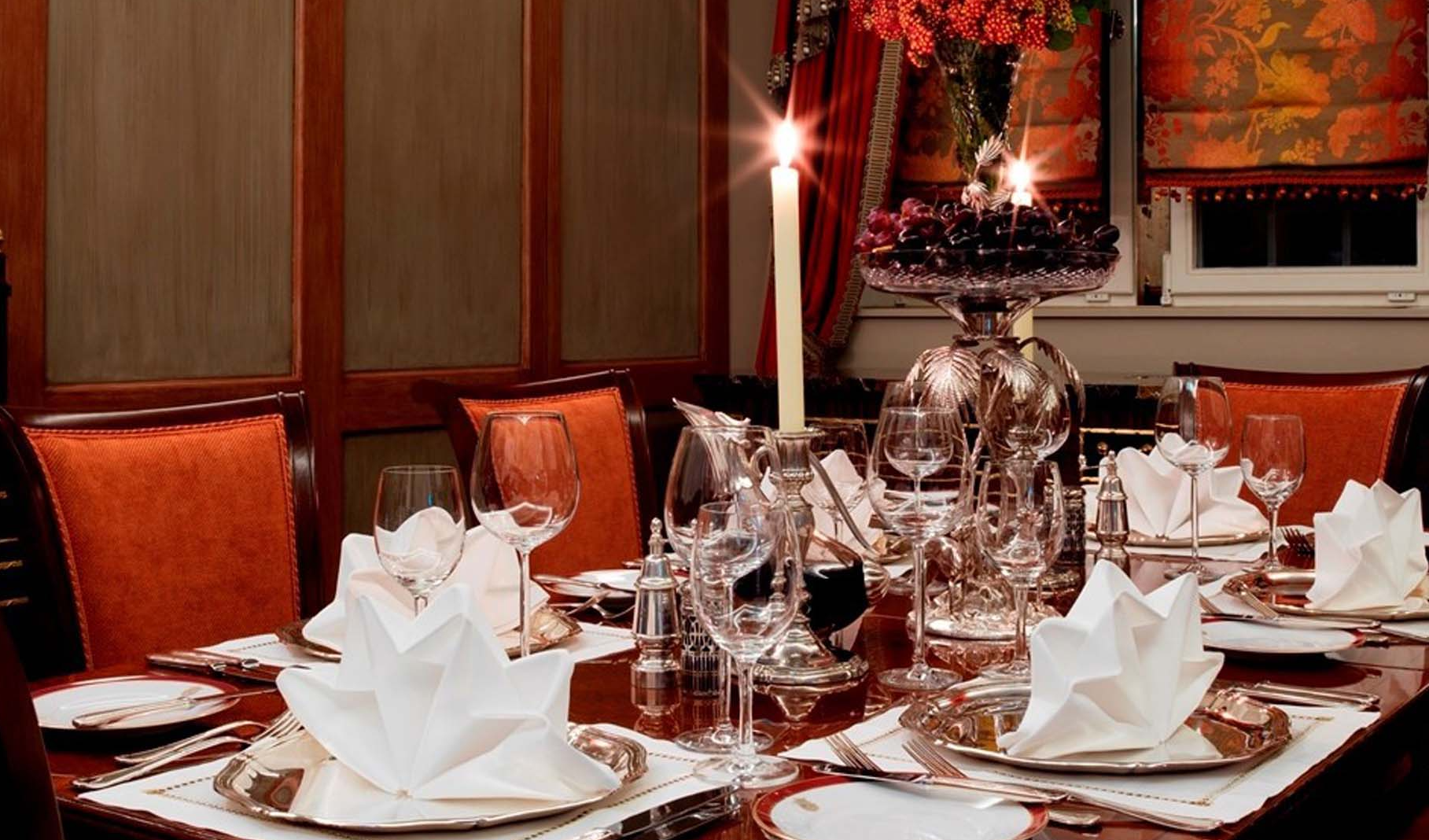
Restaurant Victoria occupies the Empress's original 1893 dining room. The Castle Lunch menu runs Wednesday through Sunday from 12:00 to 14:00 — a fine seasonal menu in the room's original chandelier-lit configuration. The Fine Dine Dinner runs Wednesday through Sunday from 18:00 to 22:00 with a choice of 3, 4, 5 or 6-course menus — German and Italian classics interpreted through contemporary technique, with the truffle pasta among the recurrent editorial standouts. The wine programme features the House of Hesse's own Prinz von Hessen Rheingau wines — Riesling and Pinot Noir produced at the family estate — alongside the wider European cellar. Jimmy's Bar handles the late-evening register with whiskies, cigars, and live piano accompaniment.
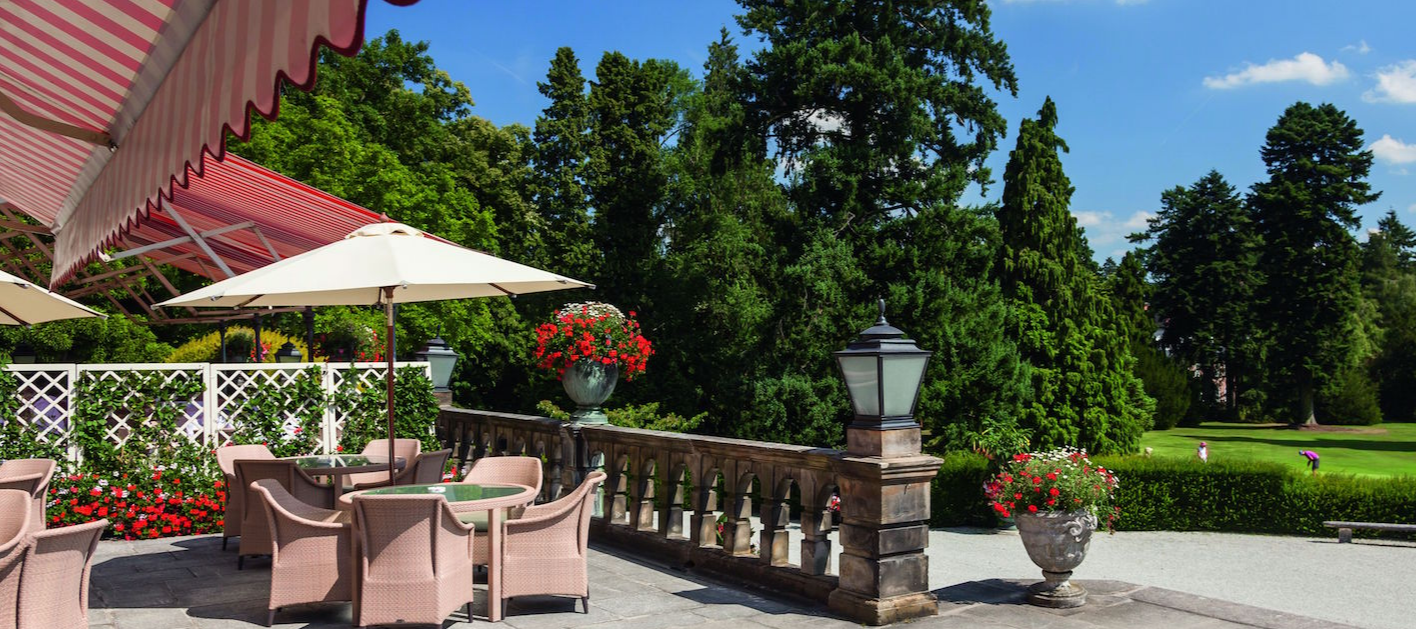
The events programme runs across the year with substantial calendar density. English Afternoon Tea — a direct continuation of the tea-party tradition Empress Victoria herself maintained at the castle — is served Wednesday through Sunday afternoons in the principal reception room or on the castle terrace overlooking the park. Monthly guided castle tours cover the property's history, the architecture and the Empress Victoria story. The Champagne Sunday (terrace, late May onwards) and Picnic in the Park (Sundays, from June) handle the summer Sunday register; Theatre on the Rotunda runs Shakespearean drama performances against the castle backdrop in June; Mother's Day Brunch, Whitsun Menu, Summer BBQ, and the First Day of School event complete the family-facing seasonal calendar. The five historic salons — Roter Salon, Grüner Salon, Blauer Salon, Kleiner Speisesaal and the Bibliothek library — host classical concerts, gourmet events, readings, weddings and corporate gatherings across capacities from 16 to 120 guests.
The Eisenhower golf course is the property's most editorially unusual amenity. Dwight D. Eisenhower lived at Schloss Friedrichshof from 1946 to approximately 1953 as Supreme Allied Commander in Europe — first when the castle housed Allied troops, then as an officers' club, then as Eisenhower's personal residence. During his years at the castle Eisenhower designed the 18-hole course that runs across the 58-hectare estate today; the course remains operational as one of the area's principal golf clubs. Horseback riding and bicycle hire run the alternative outdoor register; the climatic-health-resort designation of Kronberg makes the estate's air quality genuinely distinctive within the wider Frankfurt orbit.
Worth the journey for: travellers drawn to genuinely substantive royal-period architectural and decorative-arts heritage as the principal proposition — few European hotels match the depth of the original art collection, the architect's royal credentials, and the continuous family ownership; couples planning weddings of every scale from 16 to 150 in the historic salons or the rotunda; multi-generational family groups using the property's diverse room inventory and substantial events programme for milestone reunions; gastronomy travellers attracted to Restaurant Victoria's chef-driven dining in the Empress's original room with the Prinz von Hessen Rheingau wines; cultural travellers using the property as the Frankfurt base for the Hessian cultural circuit (Goethe House, Städel Museum, Frankfurt cathedral) and the surrounding Taunus hills. Less so for: travellers prioritising contemporary design hotels over historical inheritance (this is a genuinely period property); families with very young children who would find the formal castle register restrictive; guests wanting a small-scale boutique hotel feel (60 rooms across a 58-hectare estate operates at a different scale from intimate small properties).


