Destination, hotel name or experience

Boutique Hotels in Porto-Vecchio

Introducing Porto-Vecchio

Porto-Vecchio sits at the south-eastern tip of Corsica, on a sheltered harbour between the maritime pines of the Ospédale forest and the granite headlands of the Mediterranean coast. Founded as a Genoese citadel in 1539, the upper town retains its 16th-century fortifications and the old quarter's lanes spiral around the Place de la République and the Église Saint-Jean-Baptiste, where the fiocchi (salt pans) once supplied the Genoese trading network with the Corsican salt that gave the town its commercial importance.
 
The wider Porto-Vecchio commune extends across 35 kilometres of coastline holding what most editorial guides identify as Corsica's most aesthetically intact beaches: Palombaggia, frequently cited as Corsica's best beach, with its arc of white sand and twisted maritime pines facing the granite Cerbicales Islands; Santa Giulia, the lagoon-shaped bay south of Palombaggia; Rondinara, the perfect crescent of turquoise water between Porto-Vecchio and Bonifacio; and the smaller coves of the Cerbicales archipelago itself, the protected marine reserve offshore.

Browse on Map — Porto-Vecchio

Explore 1 exceptional boutique hotel hand-picked in Porto-Vecchio. Click a pin to discover each property.

Hotels in Porto-Vecchio

Domaine Les Oliviers de Palombaggia

France, Porto-Vecchio

Domaine Les Oliviers de Palombaggia

5-star Les Oliviers de Palombaggia — 13 restored Corsican sheepfolds with private pools on two hectares above Palombaggia, Bougon-family-run…

Porto-Vecchio Guide

The town and its harbour

The Vieille Ville (Old Town) sits on a small hill above the harbour, walled on three sides by the original Genoese fortifications. The Porte Génoise is the surviving fortified gate; the Bastion de France carries the principal viewing terrace over the harbour and the gulf beyond. The harbour itself runs between the Old Town and the marina, with the working fishing port at one end and the contemporary leisure marina at the other. Daily ferries connect Porto-Vecchio to Marseille, Toulon and Nice in mainland France, and seasonal services to Sardinia operate during summer. The Tuesday morning market on Place de la République is the weekly working version of the town, with the Corsican charcuterie tradition (figatellu, coppa, lonzu) and the Cap Corse muscat wines anchoring the producer stalls.

The Palombaggia beach arc
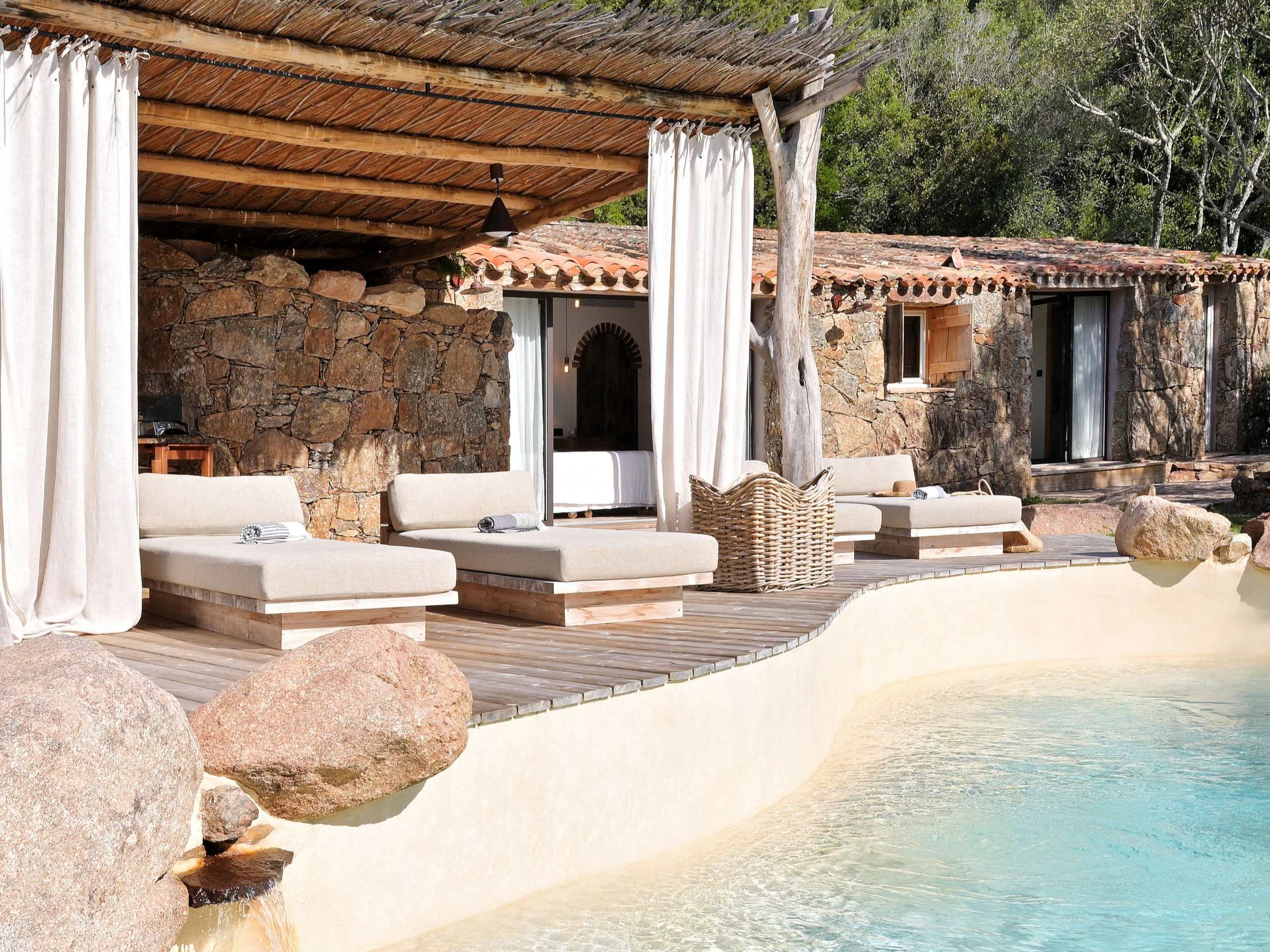
Private pool and pergola-shaded terrace at Les Oliviers de Palombaggia's dry-stone sheepfold villa, southern Corsica 📍

The Palombaggia beach arc

Palombaggia is the most photographed beach in Corsica — a long arc of white sand framed by twisted maritime pines, with the granite Cerbicales Islands visible offshore. Tamaricciu and Folaca sit immediately north as smaller variations on the same coastline; Santa Giulia sits five kilometres south as a shallow lagoon bay; Rondinara sits twenty minutes further south as a near-circular sheltered crescent. The Cerbicales Islands nature reserve is the protected archipelago offshore, five granite islets with restricted access, accessible by skipper boat for snorkelling and observing the protected colonies of Audouin's gulls, shags, and Eleonora's falcons. Les Oliviers de Palombaggia sits above the Palombaggia coastline as a 13-villa estate of restored dry-stone Corsican sheepfolds on two hectares of preserved maquis — Bougon-family-run since 1972, with the working Casa di Petra farm next door.

The interior

The Ospédale forest rises behind the town toward the granite plateau of central Corsica. The Massif de l'Ospédale carries hiking trails through the maritime pines toward the Punta di a Vacca Morta (1,314 m) and the Lac de l'Ospédale, the artificial reservoir at 850 metres elevation. Bonifacio — the clifftop citadel at Corsica's southernmost tip — sits 45 minutes south by car, with the Bouches de Bonifacio strait between Corsica and Sardinia visible from the ramparts. Sartène to the west holds the medieval Corsican village character at its most intact; Zonza and the Aiguilles de Bavella carry the alpine Corsica of granite needles and high-mountain hiking.

When to visit

May through October handles the principal Corsican season. The Mediterranean summer reaches its strongest from June through September; the beach scene runs hottest in July and August (the French summer holiday months, with crowd density at peak). The shoulder months of May, early June and September deliver the warmth and the beaches without the August crush. October retains warm-water swimming and quieter beaches. Les Oliviers de Palombaggia operates seasonally (April through October).

Frequently Asked Questions

How do I get to Porto-Vecchio?

Figari-Sud Corse Airport (FSC) is 25 minutes north by car — the closest international hub, with direct seasonal flights from Paris, Marseille, Lyon, Nice, Geneva, Brussels and London. Ajaccio Airport (AJA) is 2.5 hours away by road across the mountains. By sea, ferries from Marseille, Toulon and Nice run year-round to Porto-Vecchio's port (approximately 10-12 hours overnight). Ajaccio and Bastia ferry routes are alternatives if direct Porto-Vecchio sailings aren't available.

Which beach is the best near Porto-Vecchio?

Palombaggia is the most decorated — frequently cited as Corsica's best beach for its arc of white sand framed by twisted maritime pines, with the Cerbicales Islands visible offshore. Santa Giulia is the second principal beach, sheltered as a lagoon bay. Rondinara is the most aesthetically striking — a perfect crescent of turquoise water — and the most remote of the three. Tamaricciu and Folaca are smaller variants of the Palombaggia coastline immediately to the north.

What's the difference between Porto-Vecchio and Bonifacio?

Both sit in Corsica's southern tip, 45 minutes apart by car. Porto-Vecchio is the larger town, with the working harbour, the Genoese citadel and the beach access. Bonifacio is the smaller fortified town on the dramatic limestone cliffs at Corsica's southernmost point, with the medieval citadel perched directly above the Mediterranean and the Bouches de Bonifacio strait between Corsica and Sardinia visible from the ramparts. Most visitors anchor in Porto-Vecchio and day-trip to Bonifacio.

Can you visit Sardinia from Porto-Vecchio?

Yes — Corsica and Sardinia are separated by the Bouches de Bonifacio strait, approximately 12 kilometres at its narrowest point. Seasonal ferries operate from Bonifacio to Santa Teresa di Gallura in Sardinia in approximately one hour; some excursion operators run day-trip cruises from Porto-Vecchio and Bonifacio across the strait, taking in the Lavezzi Islands marine reserve en route.

Icon of Here for You
Here for You
Icon of Free Extras on Arrival
Free Extras on Arrival
Icon of Best Price Guarantee
Best Price Guarantee
Icon of Personally Approved Hotels
Personally Approved Hotels
Icon of Exclusive Offers
Exclusive Offers
Icon of New Finds Every Month
New Finds Every Month