Destination, hotel name or experience

Boutique Hotels in Garmisch-Partenkirchen

Introducing Garmisch-Partenkirchen

Garmisch-Partenkirchen is Bavaria's principal Alpine resort town and the gateway to Zugspitze — Germany's highest mountain at 2,962 metres — sitting at the foot of the Wetterstein range, 90 km south of Munich on the Austrian border. The town hosted the 1936 Winter Olympics and remains one of Germany's most decorated winter-sports destinations, with Garmisch-Classic (Hausberg, Kreuzeck, Alpspitze) and the Zugspitze ski terrain running 40 lifts across two resort areas. The traditional Bavarian painted-façade houses (Lüftlmalerei) line the lanes of both Garmisch and Partenkirchen — originally separate villages, controversially merged by Hitler in 1935 to host the Olympics, with the original Partenkirchen retaining the more architecturally intact older village character.


The cultural anchors run deep across the surrounding landscape. King Ludwig II's hunting castle Königshaus am Schachen (1869-1872) sits on Schachen mountain accessible only by foot. Richard Strauss lived and composed at his villa in Garmisch from 1908 until his death in 1949 (the Villa Strauss is now a museum). The dramatic Partnach Gorge (Partnachklamm) — a 700-metre canyon carved by the Partnach river — runs directly south of the town. The Bavarian Alpine character carries through both seasons: ski-and-spa in winter, hiking-and-summit in summer.

Browse on Map — Garmisch-Partenkirchen

Explore 1 exceptional boutique hotel hand-picked in Garmisch-Partenkirchen. Click a pin to discover each property.

Hotels in Garmisch-Partenkirchen

Das Graseck

Germany, Garmisch-Partenkirchen

Das Graseck

Das Graseck — a 33-room Alpine hideaway at 900m in Bavaria, reached by the 1953 Graseck cable car, with on-site preventive medicine and a…

€346.80

Price for 1 night from

Garmisch-Partenkirchen Guide

The town and Bavarian Alpine character
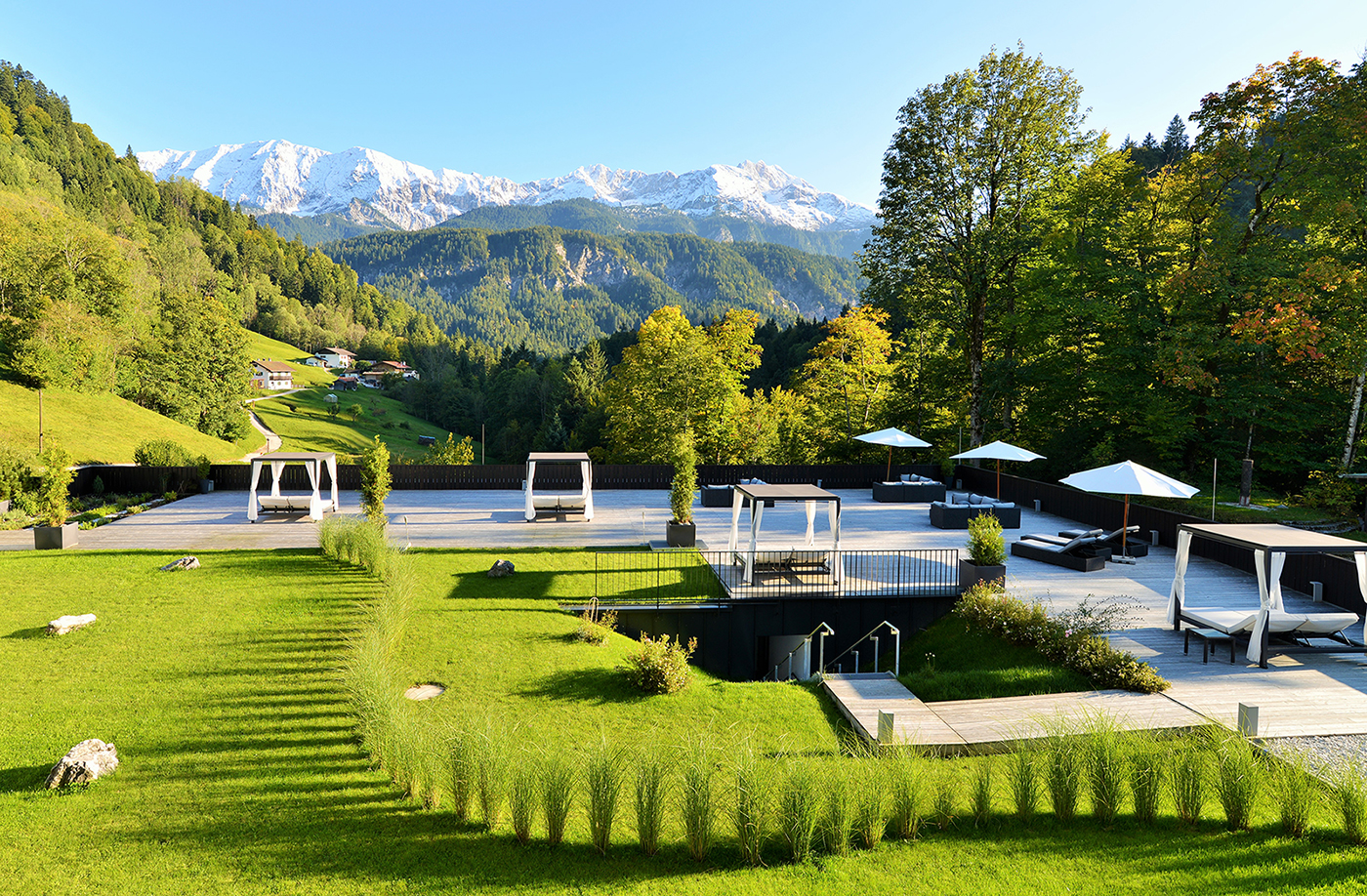
Das Graseck at 900m on the Graseck above Garmisch-Partenkirchen — contemporary Alpine architecture against the Wetterstein range 📍

The town and Bavarian Alpine character

Garmisch-Partenkirchen runs across the two adjacent villages that share the merged name. Partenkirchen — the older of the two, with Roman origins as Partanum on the Via Claudia Augusta trade route — retains the more architecturally intact older village character: the Ludwigstraße and surrounding lanes carry the painted-façade houses (Lüftlmalerei) in their original configuration. Garmisch — the newer side, more contemporary in commercial development — handles the modern resort infrastructure, the principal shopping streets and most of the contemporary hotels. The Olympic Stadium built for the 1936 Winter Olympics sits at the edge of Partenkirchen with the original ski jump (Große Olympiaschanze) still operating today as a competition venue; the Olympic Bobsleigh Run am Riessersee sits 3 km from the centre as the surviving 1936 infrastructure. Das Graseck sits at 900 metres above the town on the Graseck mountain, reached by the world's first fully automated small-cabin cable car (built 1953) — a 33-room Alpine hideaway integrating Michelin-listed dining at Weingart's with on-site clinic-level preventive medicine through the Gap Prevent centre, listed in the Michelin Guide Hotels collection.

Zugspitze and the Bavarian Alpine summits

The Zugspitze (2,962 metres) is Germany's highest mountain, accessed from Garmisch-Partenkirchen via the Bayerische Zugspitzbahn rack railway (which climbs from the town through Grainau and Lake Eibsee to the summit) or via the Eibsee cable car (the world's most modern cable car when completed in 2017, with a 1,945-metre vertical lift). The summit carries the Zugspitze glacier ski area (operational into early summer in certain years), the Münchner Haus mountain hut, the highest-altitude weather station in Germany, and the Glacier Garden restaurant. Adjacent peaks: the Alpspitze (2,628 m, the dramatic pyramidal mountain visible from the town), the Waxenstein, the Hochwanner, and Mount Schachen (1,866 m) carrying Ludwig II's Königshaus am Schachen — Ludwig's Alpine hunting lodge, built in 1869-1872 in Tyrolean Stube style with the spectacular Moorish hall on the upper floor.

Partnach Gorge and the lower mountain walks

The Partnach Gorge (Partnachklamm) — a 700-metre limestone canyon carved by the Partnach river over thousands of years — sits directly south of Garmisch-Partenkirchen and is one of Bavaria's most-visited natural attractions. The gorge runs from the Olympic Stadium entrance through the rock corridor with wooden walkways suspended along the canyon walls and waterfalls cascading from the cliffs. The walk through the gorge takes 45-60 minutes one way; continuations lead onward to the Eckbauer plateau, the Reintal valley (the principal Zugspitze hiking approach), the Vorderkainzenalm hut, and ultimately Mount Schachen. The Höllentalklamm (Hell Valley Gorge) sits in the neighbouring village of Hammersbach as a more technical alternative — equally dramatic but less crowded.

The cultural surroundings

Richard Strauss — the composer of Der Rosenkavalier, Salome, Elektra and Also sprach Zarathustra — lived in Garmisch from 1908 until his death in 1949, composing many of his late works at the Villa Strauss above the town. The Richard-Strauss-Institut in Garmisch holds the composer's archive and runs the annual Richard-Strauss-Festival in mid-June. The Werdenfels Museum in Partenkirchen covers the broader Werdenfelser Land regional folk culture, with one of the most substantial Bavarian-Alpine folk-art collections in Germany. Mittenwald — 18 km southeast — is the world's principal centre of violin-making, with the Geigenbaumuseum covering the craft tradition since 1684 and the Violin Festival running in early summer.

When to visit

Ski season runs late November through April — the peak conditions December-March, with the Zugspitze glacier extending the season into early May in good years. The Christmas and New Year weeks carry premium prices and full booking density. June through September handles the summer hiking and cultural season, with the Partnach Gorge accessible year-round but at its most dramatic in late spring with snowmelt waterfall flow. The Richard-Strauss-Festival runs mid-June; Mittenwald Violin Festival runs early-mid June. October-November are the quietest shoulder months. Das Graseck operates year-round.

Frequently Asked Questions about Garmisch-Partenkirchen

Icon of Here for You
Here for You
Icon of Free Extras on Arrival
Free Extras on Arrival
Icon of Best Price Guarantee
Best Price Guarantee
Icon of Personally Approved Hotels
Personally Approved Hotels
Icon of Exclusive Offers
Exclusive Offers
Icon of New Finds Every Month
New Finds Every Month